
Is daylight savings ending in 2026? It’s almost time to play that annual game of “hunt the snooze button” as we prepare to lose an hour of precious sleep. Yes, daylight savings 2026 is barreling toward us, and while the promise of long, light-filled evenings sounds like a dream, the morning after can feel like a nightmare.
But don’t worry, I’ve got you covered. Whether you’re here to find out exactly when we change the clocks, how to trick your body into accepting the new schedule, or whether this is the last time we do this dance, you’re in the right place. Let’s dive into everything you need to know about springing forward in 2026.
The Exact Moment: When Do We Spring Forward in 2026?
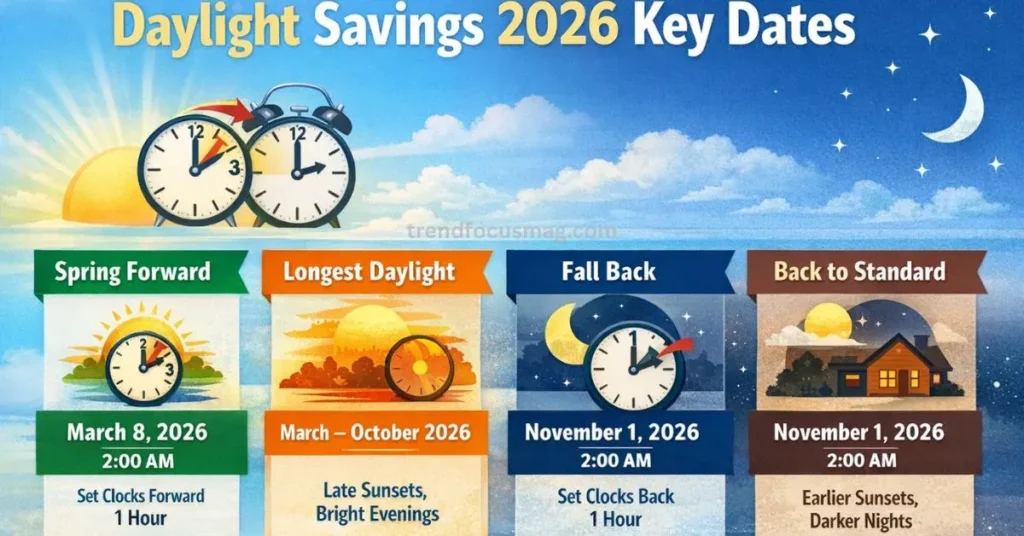
Mark your calendars and set your alarms (ironically). For most of the United States, daylight saving time starts at 2:00 a.m. local time on Sunday, March 8, 2026 .
At that moment, time magically jumps to 3:00 a.m. That means if you’re a night owl, you just lost an hour of your weekend. If you’re a parent, good luck explaining to your toddler why the sun isn’t “up” yet when the clock says it’s time to rise.
Spring Ahead!🕑 Don’t forget to set your clocks forward one hour at 2AM EST this Sunday for the start of 2026 Daylight Savings Time. pic.twitter.com/aLExhDyfdy
— Mike Holt (@MikeHoltNEC) March 7, 2026
This shift means we are moving an hour of daylight from the morning to the evening. For example, if the sun usually sets around 5:41 p.m. on Saturday, by Sunday it will be setting closer to 6:42 p.m., giving us that glorious evening light we crave .
| Event | Date | Time | What Happens |
|---|---|---|---|
| Daylight Saving Time Begins | March 8, 2026 | 2:00 AM | Clocks move forward to 3:00 AM (lose 1 hour) |
| Longest Daylight Period Starts | March – October 2026 | Evening daylight increases | Later sunsets and brighter evenings |
| Daylight Saving Time Ends | November 1, 2026 | 2:00 AM | Clocks move back to 1:00 AM (gain 1 hour) |
| Return to Standard Time | November 1, 2026 | After 2:00 AM | Earlier sunsets and darker evenings |
The Great Debate: Will This Be the Last Time?
Is daylight savings ending in 2026? You’ve probably seen the headlines. Year after year, we hear whispers that this is it—the end of the biannual clock change. So, what’s the status for 2026?
The momentum to “lock the clock” is stronger than ever, but we are currently in a state of legislative limbo.
The Push for Permanent DST
The most famous piece of potential legislation is the Sunshine Protection Act. If passed at the federal level, this bill would make Daylight Saving Time permanent, meaning no more “falling back.” We would keep those long summer evenings all winter long .
However, there is a catch (isn’t there always?). While the U.S. Senate unanimously passed a version of this bill in 2022, it stalled in the House. In 2026, the debate continues, but the major roadblock is consensus: Should we have permanent Daylight Saving Time or permanent Standard Time?
The Case for Permanent Standard Time
While many people think they want more evening light, sleep experts vehemently disagree. The American Academy of Sleep Medicine (AASM) has published position statements arguing that we should abolish DST altogether in favor of permanent Standard Time .
Why? Because Standard Time aligns better with our natural circadian rhythms. Exposing ourselves to light in the morning helps us wake up, while darkness at night helps produce melatonin. If we had permanent DST, winter sunrises wouldn’t occur until after 8:00 a.m.—or even 9:00 a.m. in some regions—forcing kids to go to school and adults to commute in pitch-black darkness .
Why Do We Still Do This? A Quick History Lesson
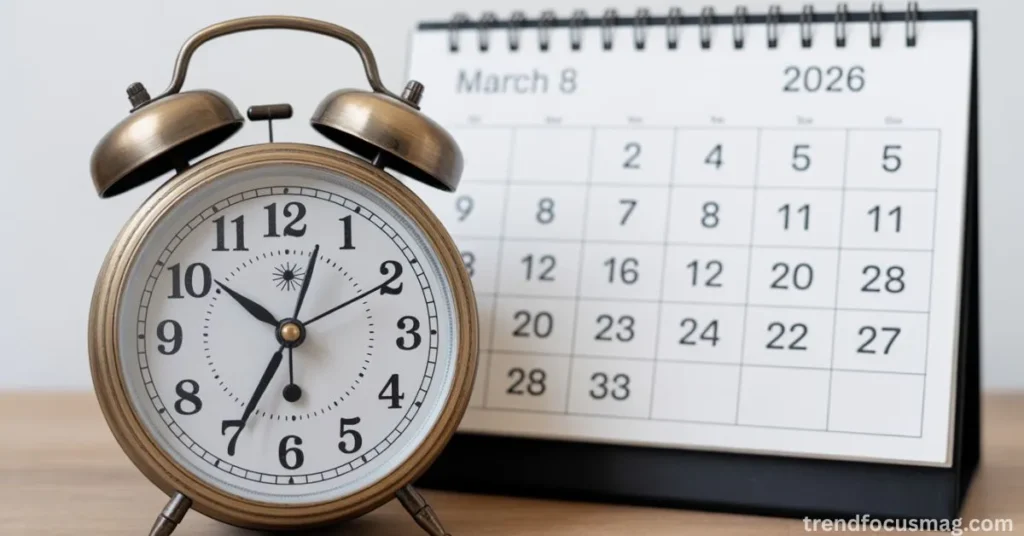
Before you curse your ancestors for this ritual, it helps to understand the “why.”
Daylight Saving Time wasn’t started for farmers, as the myth often goes. It was actually first adopted in the UU.S.back in 1918 as a wartime measure during World War I to conserve fuel . The logic was simple: if there is more daylight at the end of the day, people will use less artificial light, saving energy for the war effort.
We brought it back during World War II, and it became permanent law in 1966 with the Uniform Time Act . However, modern studies show the energy savings are negligible—a Department of Energy study found it reduces electricity consumption by only 0.03% . So, we are basically disrupting our sleep for a fraction of a percent in savings.
The Health Impact: It’s More Than Just Tiredness
We tend to laugh off the “hour loss” with coffee jokes, but the impact on your body is serious biology.
Your Body on DST
When we spring forward, we are essentially inducing a form of social jet lag. Your internal clock—or circadian rhythm—is synced to the sun, not your smartphone. When you force it to shift abruptly, every cell in your body feels the lag.
According to chronobiologist Emily Manoogian, the shift affects everything from your heart to your gut. Studies show that the rate of heart attacks and strokes ticks upward in the days immediately following the March time change . For those with existing health conditions like obesity or diabetes, this one-hour shift can disrupt glucose regulation for up to four days. This happens because your melatonin levels, which suppress insulin secretion, are still high when you wake up, meaning your body isn’t ready to process breakfast .
Even your gut isn’t safe. Research has found an increase in medical leaves for those suffering from inflammatory bowel diseases like Crohn’s disease right after the switch, as the stress on the body triggers flare-ups .
5 Proven Strategies to Beat the Clock in 2026
Okay, enough doom and gloom. You can’t stop the clock, but you can outsmart it. Here is how to adjust to daylight saving time without feeling like a zombie.
Start Shifting Your Schedule Now
Don’t wait until Sunday morning. Starting sleep schedule on Wednesday or Thursday before March 8, start going to bed 15 minutes earlier and setting your alarm 15 minutes earlier each day . By the time Sunday rolls around, you’ll only have a 30-minute deficit instead of a full hour. It’s like paying off a debt in installments instead of a lump sum.
Use Light to Your Advantage
Light is the master control switch for your brain. On Sunday morning, get outside into the sunlight as early as possible. This helps signal to your suprachiasmatic nucleus (the brain’s clock) that it’s time to be awake . Conversely, dim the lights in the evening a few days before the change to help your melatonin production shift.
Rethink Your Breakfast
This is a fascinating tip from sleep experts. Because your body might not be ready to handle glucose efficiently right after the time change, avoid sugary cereals, lattes, and donuts for the first few days. Manoogian suggests waiting an hour after waking to eat, or opting for a high-protein meal like an omelet with avocado to keep your blood sugar stable .
Nap Strategically
If you crash on Sunday afternoon, that’s okay. However, keep it short. A power nap of 20 minutes can recharge your batteries without making it harder to fall asleep Sunday night . Anything longer than that, and you risk entering deep sleep, which will leave you groggier and disrupt your night.
Protect Your Sleep Hygiene
This is the week to lock in the rules. Stop looking at screens at least an hour before bed, avoid heavy dinners, and skip the nightcap. Alcohol might help you fall asleep, but it ruins the quality of your slow-wave sleep, making the adjustment even harder .
Where DST is Skipped (And Where It’s Changing)
While most of the U.S. participates, there are notable holdouts.
States that don’t observe DST:
- Hawaii: Being near the equator, the daylight length doesn’t vary enough to justify the switch.
- Arizona (except the Navajo Nation): The reasoning is practical—they don’t want an extra hour of sun to bake the state during its scorching summers .
International Update:
Interestingly, our neighbors to the north are making moves. The Canadian province of British Columbia has announced that March 8, 2026, will be its last time change. They are switching to permanent daylight saving time, meaning after they spring forward this weekend, they won’t fall back in November . Premier David Eby stated the move is about “making life easier for families” and reducing disruptions .
State-by-State: The 2026 Legislative Landscape
The movement to stop the time change is bubbling up at the state level, even if federal law hasn’t caught up yet.
Kentucky
House Bill 368 was introduced in Kentucky to exempt the Commonwealth from DST entirely. If passed, Kentucky would observe standard time year-round, effective October 31, 2026 . However, like all states, this change requires federal approval to actually take effect.
Illinois
In Illinois, House Bill 0039 proposes a different route: making daylight saving time permanent for the entire state. The bill suggests that after springing forward in March 2026, the state would not fall back, locking in DST year-round .
Virginia
The debate in Virginia is particularly heated. While Delegate McNamara’s HB9 proposes permanent DST, public comments to the legislature are overwhelmingly opposed. Sleep physicians, parents, and residents are pleading with the state to stick with Eastern Standard Time, citing the dangers of sending kids to school in the dark . One resident noted that permanent DST would mean sunrises after 8:30 a.m. in January, which they called “depressing and dangerous” .
Don’t Forget Your Smoke Detectors!
Amidst all the debate about federal law and health impacts, here is a life-saving tip that gets lost in the shuffle.
The Firemen’s Association recommends using the daylight saving time change as a reminder to replace the batteries in your smoke detectors and carbon monoxide alarms . It’s a simple habit: Spring Forward, Check Your Alarms. About 60% of home fire deaths occur in homes without working smoke alarms. A fresh battery twice a year can literally save your life.
Deals and Steals: Retailers Cash In
Feeling tired? So are the retailers, but they are ready to help you (and your wallet) cope.
In a fun marketing twist, several major chains are offering “Daylight Saving Deals” to help you spring forward.
- Walmart has a massive collection of “daylight saving deals” featuring clocks, lamps, blackout curtains, and new coffee makers to help you wake up .
- Kroger is offering “Spring into Daylight Saving Time” promotions, including free breakfast giveaways on March 7 to help fuel your groggy morning .
- Home Depot is also joining the fun with savings on clocks, mattresses, and home decor .
So, if you need a new extra-strong coffee maker or some blackout curtains to trick your brain into sleeping while the sun is still up, now is the time to shop.
When Does It End? Is daylight savings ending in 2026?
🚨 BREAKING: Congress are pushing to make Daylight Saving Time permanent.pic.twitter.com/QPHpaupx5F
— Derrick Evans (@DerrickEvans4WV) January 19, 2026
If you are already dreading the darkness of winter, mark your calendar for the flip side. Daylight saving time 2026 ends on Sunday, November 1, at 2:00 a.m. . That is when we “fall back” and gain that glorious hour of sleep back. Interestingly, this falls right after Halloween, meaning those trick-or-treaters might get an extra hour of daylight for their candy haul this year.
Is daylight savings ending in 2026?
“Daylight Saving Time isn’t ending permanently in the United States anytime soon. Despite repeated efforts such as the Sunshine Protection Act, Congress has not passed a federal law to stop the clock changes. Lawmakers remain divided between permanent DST and permanent Standard Time, though many sleep experts favor Standard Time for health reasons. Until federal law changes the Uniform Time Act, Americans will continue switching clocks twice each year.”
Conclusion
Love it or hate it, daylight saving time 2026 is coming. While the debate in Washington drags on, we are left to deal with the reality of the clock change this weekend. Is daylight savings ending in 2026? The answer is Not yet.
Use the tips above to ease the transition, be patient with your body (and your kids), and maybe treat yourself to a fancy coffee on Monday morning—you’ll have earned it. And who knows? With British Columbia leading the charge and U.S. states piling on the pressure, this might actually be one of the last times we have to write this guide.
Frequently Asked Questions (FAQs)
Will daylight savings time continue in 2026?
Yes. Daylight savings 2026 will continue across most of the United States since federal law has not yet ended the seasonal clock change.
When to change clock in 2026?
For daylight savings 2026, clocks move forward one hour at 2:00 a.m. on March 8, 2026 and move back at 2:00 a.m. on November 1, 2026.
Is daylight savings time coming to an end permanently?
Not yet. Several proposals exist, including the Sunshine Protection Act, but no permanent nationwide change has been approved.
What states are considering getting rid of daylight savings time?
States including Kentucky, Illinois, Florida, and Virginia have introduced bills exploring either permanent standard time or permanent daylight saving time.
What states are considering getting rid of daylight savings time?
More than 30 U.S. states have discussed legislation to stop the clock change, though most still need federal approval before making any permanent adjustment.
More from TrendFocusMag:
Minecraft PlayBattleSquare 2026: Tips, Tricks & Competitive Guide
The Shift Toward Pedestrian-Centric Urban Planning in 2026
10 Unique Florida Souvenirs at 2026 Annual Floridiana Fest Sarasota

Our mission is to provide timely, trustworthy, and impactful stories that help our audience stay informed in a fast-moving world.