
Can Cats See in the Dark? Cats cannot see in complete darkness, but they can see extremely well in very low light. Their eyes contain a reflective layer called the tapetum lucidum that helps capture more light. Because of this, cats can see about six times better than humans in dim environments.
It’s a quiet evening, and I’m curled up on the sofa, maybe watching a replay of Lindsey Vonn’s latest run down the mountain. The room is dim, lit only by the soft glow of the television. My cat, however, is not relaxing. She’s perched on the back of the armchair, her eyes wide and fixed on something in the shadowy corner of the room that I absolutely cannot see. It’s in these quiet moments that I always find myself wondering the same thing: can cats see in the dark in a way that we simply can’t? We’ve all heard the saying, but what is the real story behind those luminous eyes? Let’s curl up and explore the mystery of how our feline friends truly navigate the night.
Can Cats See in the Dark Better Than Humans?
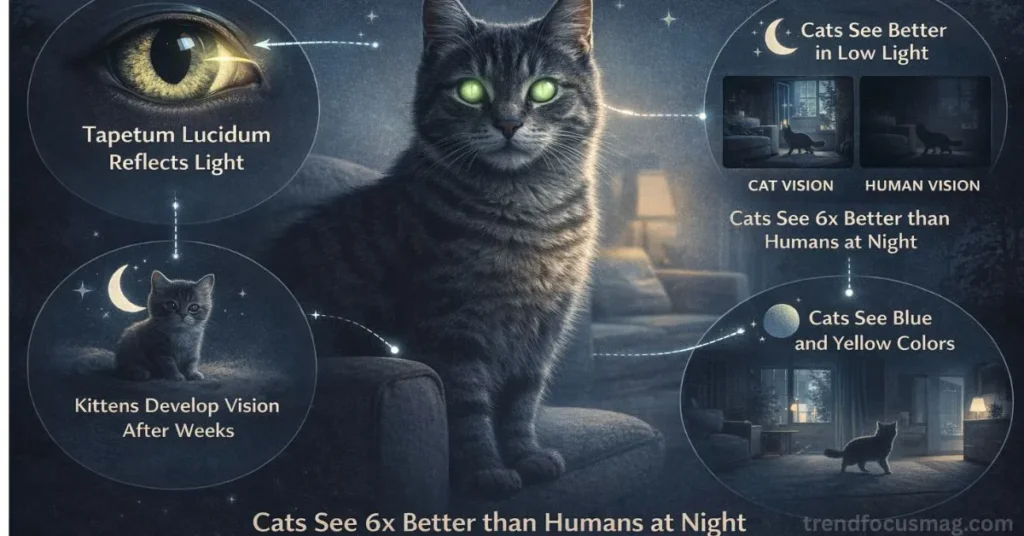
Dr. Paul E. Miller, a veterinary ophthalmologist at the University of Wisconsin-Madison, has published extensively on this topic. In a symposium paper, he states that cats have a minimum light detection threshold “up to 6 times less than that of humans” . He also notes that the feline tapetum lucidum, the reflective layer behind the retina, can reflect “up to 130 times more light than the human fundus” .
This is the heart of the matter, and the simple answer is a resounding yes. Their ability to see in low light is leagues ahead of our own. While we stumble around trying to find the light switch, a cat can navigate the same space with an almost supernatural grace. Science tells us that in very dim light, cats can see six to eight times better than we can . It’s not magic, but a masterpiece of biological engineering.
Their eyes are built like little cameras optimized for twilight. For starters, their pupils can dilate to cover most of the eye, letting in every possible scrap of available light . Behind the retina, they have a special mirror-like layer called the tapetum lucidum. This is the real star of the show. It reflects light that passes through the retina back onto it, giving the light-sensitive cells a second chance to capture it . This is also what causes their eyes to glow that eerie green or gold when you shine a light on them in the dark.
Can Cats See in Color?
A foundational study from 1969, published in The Journal of Physiology, used electrophysiological recordings to investigate cat color vision. The researchers found “lack of evidence for more than one cone type” . This strongly supports the conclusion that cats do not see the full spectrum of color and primarily rely on rods (for low light) and a single class of cones.
Little knowledge of cats: vision
— Erguang Bio-tech (@gjyc_pet) January 6, 2026
Cats are weak in color. They can only see blue, green and yellow. pic.twitter.com/qieZ8MaIGj
Before we dive into the shadows, it helps to understand what a cat’s everyday world looks like. For a long time, many of us assumed our pets saw the world in black and white, like an old movie. It turns out, that’s not quite right. The truth is a little more nuanced and quite beautiful. Cats don’t see the vibrant rainbow that we do, but they aren’t living in a grayscale world either .
Their vision is more akin to a human with color blindness. They have cones in their eyes that allow them to perceive shades of blue and yellow, along with various tones of gray . So, that bright red toy mouse you bought might actually look like a dull gray or brownish spot to them. A sunny yellow or a sky-blue toy, however, would stand out much more against a green carpet. It’s a softer, more muted palette, perfectly designed for their needs as hunters .
What Age Can Cats See in the Dark?
If you’ve ever had the joy of raising a tiny kitten, you know they start out pretty helpless. Those little fluffballs are born with their eyes tightly shut, and even when they first open, their vision is very blurry and underdeveloped. A kitten’s eyes and the neural pathways to their brain need time to mature . Their night vision isn’t something they’re born with; it develops over the first few weeks and months of life.
For a very young kitten, the world is a confusing place, and they might even feel a bit disoriented in the dark. They rely heavily on their mother and littermates. As they grow, their eyes develop the full range of low-light adaptations. By the time they are around ten to twelve weeks old, their vision is usually fully mature, and they begin to possess that incredible ability to see in what we would consider near-darkness . That’s when those midnight zoomies usually kick in!
Can Dogs See in the Dark?
It’s only natural to compare our furry family members. If you have both a cat and a dog, you might notice they act very differently come nightfall. Both species have better night vision than humans, thanks to having that same reflective tapetum lucidum and more rod cells in their eyes . But if we put them head to head in a dimly lit room, the cat would win, hands down.
Cats have eyes that are proportionally larger than dogs’ eyes, relative to their head size, which allows them to take in even more light . Their pupils can also dilate more extensively. Dogs have impressive night vision, certainly enough to navigate a dark yard, but cats are the true specialists . Their entire predatory history is built around being most active at dawn and dusk, so their eyes are simply fine-tuned for that specific type of light.
What Do Cats See When They Look at Humans?
This is a question that melts my heart a little. Given everything we know about their vision, what must we look like to them? The answer is both humbling and sweet. Because cats are nearsighted, you are a bit of a blur from across the room . They can see your face clearly from about six to twenty feet away, but up close, things sharpen up . They likely don’t rely on recognizing our specific facial features to know who we are .
Instead, they build a picture of us using all their senses. They know our scent, the sound of our voice, and the particular way we walk . When they look at us, they might not see every detail, but they see their caretaker. Some researchers even suggest they might see us as a larger, non-hostile version of a cat, part of their social group . That slow blink they give you from across the room? That’s their way of saying they trust you and feel safe. They see you, just not in the way we see ourselves.
Can Cats See in the Dark to Use the Litter Box?
Thankfully, yes. This is a common concern for new cat owners who worry about their pet navigating the house at night. Because they have such superior low-light vision, finding their litter box in a dark basement or a dimly lit laundry room is not a problem for them. As long as there is a tiny bit of ambient light—perhaps from under a door or the moonlight through a window—their incredible pupils and tapetum lucidum will capture enough to guide them .
It’s also worth noting that cats rely on more than just sight. Their powerful sense of smell plays a huge role in locating their toilet area. So even in a completely dark room, their nose would lead them right where they need to go. You can rest easy knowing your cat won’t have any midnight accidents due to poor visibility.
Can Cats See in the Dark Better Than Dogs?
As we touched on earlier, the short answer is yes, they do. While both species are equipped for low light, cats have the edge. Think of it as dogs having a very good nightlight, while cats have the full moonlight. The difference comes down to anatomy. A cat’s eye is more specialized for their crepuscular (dawn and dusk) hunting lifestyle .
Veterinary ophthalmologists point out that a cat’s tapetum lucidum is often more efficient at reflecting light than a dog’s . Additionally, because cats are typically ambush predators, their eyes are set slightly more forward on their face, giving them better depth perception for judging distances in low light. So, if you’re comparing the two, cats definitely take the crown for night vision .
Can Cats See in the Dark With a Night Light?
A team of researchers from the Gwangju Institute of Science and Technology (GIST), led by Professor Young Min Song, studied cat eyes to develop better robotic vision. Their research, published in the journal Science Advances in 2024, confirms that a cat’s vertical slit pupil helps control light, while the tapetum lucidum “boosts their night vision, giving their eyes that familiar glow” . This research validates that these specific adaptations are key to their low-light prowess.
They absolutely can, and they don’t even need it. A night light provides far more illumination than a cat actually requires to see perfectly well. In fact, you might notice that your cat prefers the room to be completely dark. That bright little night light could actually be slightly annoying to them, as their eyes are so sensitive .
However, there is one exception. If you have a senior cat whose vision might be declining due to age or conditions like cataracts, or a very young kitten that is still adjusting, a small night light can be a gentle and helpful guide . For a healthy adult cat, though, the dark is their happy place. They rule the night, with or without our artificial help.
Can Cats See Ghosts?
Ah, the fun one. You’ve definitely seen it before: your cat suddenly staring intently at an empty corner, following something invisible with their eyes. It’s easy to joke that they’re communing with the spirit world. The more scientific explanation, while perhaps less spooky, is still pretty cool. Cats are simply sensing things our dull human senses miss .
They say that children and cats can see ghosts and spirits that adults cannot. That Jolly the Scarecrow also seems to see spirits implies that this is a gift reserved for the demented. #darkfantasy #stitchedrealms #storyhook #microfiction #monsterhunting #originalfiction pic.twitter.com/SsET3manD9
— Stitched Realms (@stitchedrealms) March 10, 2026
Their vision is so sharp that they can detect tiny flickers of light, like dust motes floating in a sunbeam or the subtle reflection of a car’s headlights on the ceiling . They can also hear high-frequency sounds, like mice scratching in the walls, that are completely inaudible to us. So when your cat is staring at “nothing,” they are likely watching or listening to something very real, just something you can’t perceive. They aren’t seeing ghosts; they are just hyper-aware of the living world around them.
Can Kittens See in the Dark?
As we covered earlier, kittens aren’t born with the amazing night vision of an adult cat. It’s a skill they have to grow into. In their first few weeks of life, their eyes are still developing, and the crucial parts like the tapetum lucidum aren’t fully functional yet . A young kitten will have much poorer vision in the dark than an adult cat, which is why they stay so close to their mother.
As they grow and explore, their eyes finish developing, and by the time they are a few months old, their night vision is fully operational. That’s the moment they transform from a wobbly baby into a confident little predator ready to pounce on a crinkly toy at 3 a.m. Watching them grow into their abilities is one of the most rewarding parts of being a cat owner.
So, the next time you see your cat moving gracefully through a dark room, you’ll know the secret behind their steps. It’s a beautiful combination of biology and instinct, a testament to their wild roots. They might not be able to see in total, absolute blackness, but in the dim, quiet hours of the night, they see a world we can only imagine. It’s just one more reason to admire these quiet, mysterious companions who share our homes. Maybe tonight, you can turn off the lights, watch your cat for a moment, and try to see the world through their eyes.
Comparison Table: Cats vs Humans vs Dogs Night Vision
| Question | Short Answer |
|---|---|
| Can cats see in complete darkness? | No, cats cannot see in total darkness. They still need a small amount of light to see clearly. |
| Can cats see in the dark better than humans? | Yes, cats can see about six times better than humans in very low light conditions. |
| Can kittens see in the dark? | Newborn kittens cannot see well in the dark. Their night vision develops as their eyes mature after a few weeks. |
| Do cats need a light at night? | No, most cats do not need a light at night because their eyes can use very dim light. |
| Why do cats’ eyes glow in the dark? | Cats’ eyes glow because of a reflective layer called the tapetum lucidum that reflects light inside the eye. |
Conclusion
Living with a cat often means sharing small nighttime moments. A soft step across the hallway, a gentle jump onto the couch, or a pair of reflective eyes shining briefly in dim light. These simple scenes remind us how differently cats experience the night compared with humans.
So when people ask can cats see in the dark, the answer becomes clear through both science and daily life. Cats do not see in complete darkness, yet their eyes are built to capture the smallest hints of light around them. That ability helps them move with quiet confidence while the rest of the house sleeps. Watching your cat glide through a dim room can feel almost mysterious, but it is simply the natural design of an animal perfectly adapted to the calm hours of night.
FAQs
1. Can cats see in complete darkness?
No, cats cannot see in complete darkness. They still need a small amount of light, but their eyes can use very dim light much better than human eyes.
2. Can cats see in the dark better than humans?
Yes, cats can see in the dark much better than humans because their eyes capture more light and contain a reflective layer that improves low light vision.
3. Can kittens see in the dark?
Very young kittens cannot see well in the dark because their eyes are still developing. Their night vision becomes stronger after a few weeks as their eyes mature.
4. Do cats need a light at night?
Most cats do not need a light at night. Even small amounts of natural or indoor light are enough for them to move around safely.
5. Why do cats’ eyes glow in the dark?
Cats’ eyes glow because of a reflective layer called the tapetum lucidum. It reflects light inside the eye and helps cats see better in dim environments.
More from TrendFocusMag:
FCPS Weather Alerts Closings & Delays
The Impact of Technology on Reading Habits and the Publishing Industry
How Reading Boosts Your Personal and Professional Growth

Our mission is to provide timely, trustworthy, and impactful stories that help our audience stay informed in a fast-moving world.