
Meteor Boom in Northeast Ohio: If you were jolted awake or felt your house shake on March 17, 2026, you weren’t imagining things. A loud boom in Northeast Ohio sent thousands of residents scrambling to social media, asking if it was an earthquake, a military exercise, or something out of this world. Well, it turns out the answer was written in the stars—or rather, flying through them.
According to the National Weather Service in Cleveland, the massive boom that rattled windows from Medina to Ashtabula was likely caused by a meteor . Specifically, it was a sonic boom generated by a space rock hurtling through the atmosphere faster than the speed of sound. This isn’t just speculation; meteorologists used satellite data to confirm the event .
Video from a bus garage camera
Video from our bus garage camera. A meteor in the sky. This is authentic. pic.twitter.com/8XhvovGh1z
— Dr. Jim Lloyd (@DrJimLloyd) March 17, 2026
In this post, we’re diving deep into what happened, why it made that terrifying noise, and whether you should be on the lookout for space rocks in your backyard. We’ll also break down the science of fireballs and sonic booms in a way that’s easy to digest. Buckle up—we’re going on a journey from the cosmos to your front porch.
Key Details of Meteor Boom in Northeast Ohio
To give you a quick snapshot of what went down on March 17, here are the critical facts as reported by the NWS and local news outlets .
What Actually Caused the Loud Boom in Ohio?
When you hear a noise powerful enough to shake the foundations of your home, your first thought isn’t usually “oh, it must be a rock from space.” But in this case, that is exactly the reality.
The NWS Confirmation
The National Weather Service office in Cleveland doesn’t usually track aliens, but they do track lightning. Using the Geostationary Lightning Mapper (GLM) on their satellites, they spotted something unusual. The GLM is so sensitive that it can detect the intense light and heat signature of a meteor breaking apart, which looks similar to a lightning flash but with distinct characteristics . When they saw that signature at precisely 9:01 a.m., directly correlating with the hundreds of public reports of a boom, they connected the dots.
The latest GLM imagery (1301Z) does suggest that the boom was a result of a meteor. pic.twitter.com/CH7oJ4Q1OY
— NWS Cleveland (@NWSCLE) March 17, 2026
Sonic Boom vs. Explosion
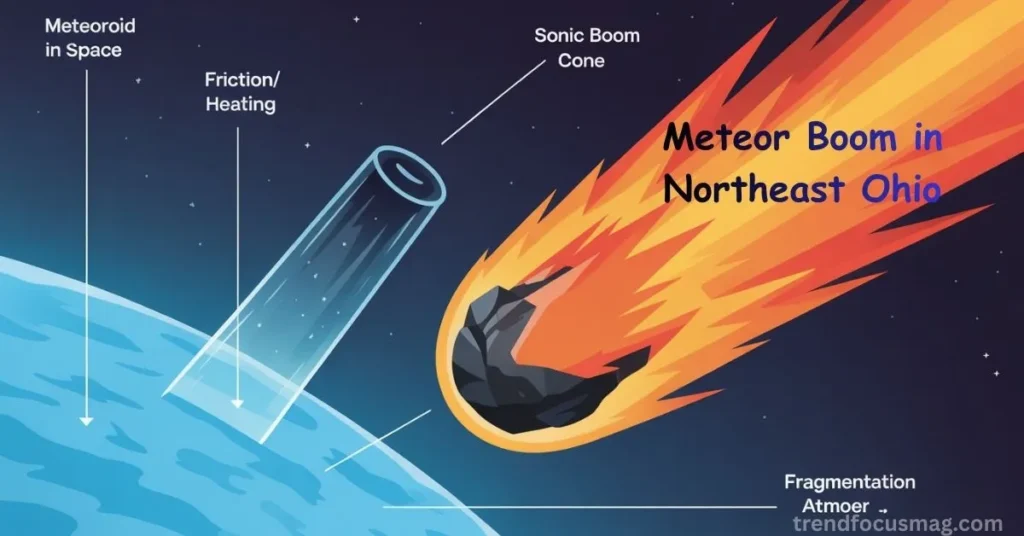
Let’s clear up a common point of confusion. This wasn’t a “meteor explosion” in the sense of dynamite going off. It was a sonic boom. Imagine you’re standing by a highway. A sports car zooms past. You hear the “vroom” after it passes, right? Now, imagine that car is going 10,000 miles per hour. The sound waves can’t get out of the way fast enough; they pile up into a single, powerful shockwave .
That shockwave is what slammed into Northeast Ohio. As one expert noted, when an object goes faster than the speed of sound (767+ mph), it displaces air so violently that it creates a pressure wave we hear as a boom . Most meteors burn up silently high above, but this one was large enough—likely the size of a mini-fridge or small doghouse—to punch deep into the lower atmosphere where the air is dense enough to carry that sound to the ground .
Expert Analysis: Understanding the Meteor’s Size and Path
To really understand what happened over Ohio, I reached into the expertise of astronomers who study these events daily. While we wait for the American Meteor Society to plot a precise trajectory based on eyewitness reports, we can make some educated guesses.
Ben Bromley, a professor of astronomy, previously explained that for a meteor to create a boom loud enough to shake houses, it needs to be relatively sizable. We aren’t talking about a grain of sand (which creates a faint shooting star). We’re talking about an object roughly 3 to 6 feet in diameter .
This specific meteor was likely a bolide—a fancy term for a very bright meteor that explodes in the atmosphere. The fragmentation seen in some doorbell videos, where the fireball appears to break into pieces, is classic bolide behavior. As the space rock plummets, the friction with our atmosphere superheats it. If it has cracks or weak points, the stress of the pressure (called ram pressure) causes it to rupture.
The “Crackling” Sound Mystery
Interestingly, some residents in Medina County reported hearing a “crackling” sound before the main boom . How is that possible if sound travels so slowly? This is one of the coolest mysteries in astronomy. Some researchers believe that very low frequency (VLF) radio waves emitted by the meteor‘s plasma trail can actually cause physical objects on the ground—like eyeglass frames, wire fences, or even your hair—to vibrate, creating an audible sizzling or crackling sound right as the light appears . It’s like the meteor is whispering right next to your ear, even though it’s miles away.
Eyewitness Accounts and Video Evidence
The human element of this story is what makes it so gripping. This wasn’t just a blip on a scientific instrument; it was a visceral experience for millions.
1:02 mark of the loud boom in Cleveland today. They are saying a #Meteor! The house shook, it was scary. pic.twitter.com/hN9X9SWrs4
— Cooper Jack & Biggie Smalls (@MiniRetrie27785) March 17, 2026
- The House Shaker: A viewer in Strongsville didn’t just hear the boom; they felt it. Reports indicated that the force was enough to knock picture frames off walls and books off shelves . That requires a significant pressure wave.
- Industrial Hum: In Medina, workers inside a busy industrial plant—a place usually filled with the constant drone of heavy machinery—heard the boom clearly over the noise . If it can cut through that kind of ambient sound, you know it was potent.
- The Canine Reaction: One Medina resident reported that her dogs wouldn’t stop barking for several minutes after the event . Animals are often more sensitive to low-frequency sounds and ground vibrations than humans, acting as furry, four-legged seismographs.
The National Weather Service captured a meteor in the sky this morning… if you heard a loud boom, this is why! The meteor streaked through the sky in Pittsburgh, into Eastern Ohio. 📹 @NWSPittsburgh pic.twitter.com/zr5DTzSvE9
— 100.1 FM and AM 1020 KDKA (@KDKARadio) March 17, 2026
Perhaps the most compelling evidence comes from technology. The Olmsted Falls School District shared footage from their bus garage camera, capturing the flash of light as the meteor streaked by . This follows a growing trend of doorbell and dash cameras acting as accidental sky surveys, providing scientists with valuable data on trajectory and brightness .
Could There Be Meteorites on the Ground?
This is the million-dollar question for rockhounds and space enthusiasts in Ohio. Did any pieces survive the fiery journey?
Currently, the National Weather Service stated, “We have not heard of anything actually hitting the ground” . However, that doesn’t mean it’s impossible. The bright fragmentation we saw suggests that the main body broke apart. Small fragments, or meteorites, could have rained down over a wide area, likely in a remote or rural part of Northeast Ohio.
If you think you’ve found a meteorite, here are a few tips:
- The Magnet Test: Most meteorites contain iron and will attract a magnet.
- The Crust: They often have a thin, black, glassy fusion crust from the melting surface.
- The Weight: They are usually much denser and heavier than typical Earth rocks.
If you find one, contact a local university or geology club. Don’t just keep it in your pocket—these rocks are scientific treasures that can tell us about the early solar system!
How Common Are Meteor Sonic Booms?

While this event feels like a once-in-a-lifetime occurrence for Ohio residents, these events happen more frequently than you might think—they just usually happen over the ocean or unpopulated areas.
- Daily Bombardment: About 100 tons of space debris hits our atmosphere every day. Most of it is dust .
- Yearly Booms: A meteor large enough to create a sonic boom (roughly the size of a basketball to a mini-fridge) occurs somewhere on Earth about once a year .
- The Big Ones: A city-buster like the Chelyabinsk meteor (which injured 1,500 people in Russia in 2013 via shattered glass) happens once every 50-100 years. That meteor was about 65 feet wide . Ohio’s visitor was likely much smaller, which is why we have cool stories instead of damage.
For more information on how scientists track these events, you can visit the American Meteor Society to view fireball reports, or check out the Geophysical Institute’s breakdown of meteor sounds. For the latest updates on this specific story, refer to the National Weather Service Cleveland website.
Conclusion
The Meteor Boom in Northeast Ohio served as a dramatic reminder that we live in a shooting gallery of space debris. It turned a Tuesday morning into a memory, sparked conversations about astronomy, and gave us all a healthy respect for the power of the cosmos.
While the immediate danger has passed, the investigation hasn’t. Scientists will be analyzing videos to determine the trajectory and origin of this space rock. Was it a piece of an asteroid? A fragment of a comet? For now, we can just be thankful that this visitor from the stars only wanted to say “boom,” and nothing more.
If you managed to capture the flash on camera, or if you felt the shake, share your story in the comments below. We’d love to hear your experience
Frequently Asked Questions (FAQs)
Was the loud boom in Northeast Ohio today an earthquake?
No. While it shook the ground, the signature was wrong for an earthquake. The National Weather Service confirmed via satellite imagery that it was a meteor creating a sonic boom .
What time did Meteor Boom in Northeast Ohio happen?
The boom occurred just before 9:00 a.m. Eastern Time on Tuesday, March 17, 2026 .
Did the meteor hit the ground?
There are no reports of an impact or a crater. It is believed the meteor burned up or fragmented entirely in the atmosphere .
Why was it so loud if it was high in the sky?
The object was traveling faster than the speed of sound. This creates a shockwave (sonic boom) that expands in a cone all the way to the ground, similar to a fighter jet breaking the sound barrier .
Can I still see the meteor?
The meteor itself is gone. However, many doorbell and security camera videos have surfaced online showing the bright fireball streaking across the sky .
More from TrendFocusMag:
Ghostbusters Jennifer Runyon Dies at 65: Cause of Death, Career, and Legacy
Joan Lunden at 75: Memoir Reveals Shocking TV Boss Incident
Jim Carrey César Award Speech 2026: Emotional French Tribute Moves the World

Our mission is to provide timely, trustworthy, and impactful stories that help our audience stay informed in a fast-moving world.