
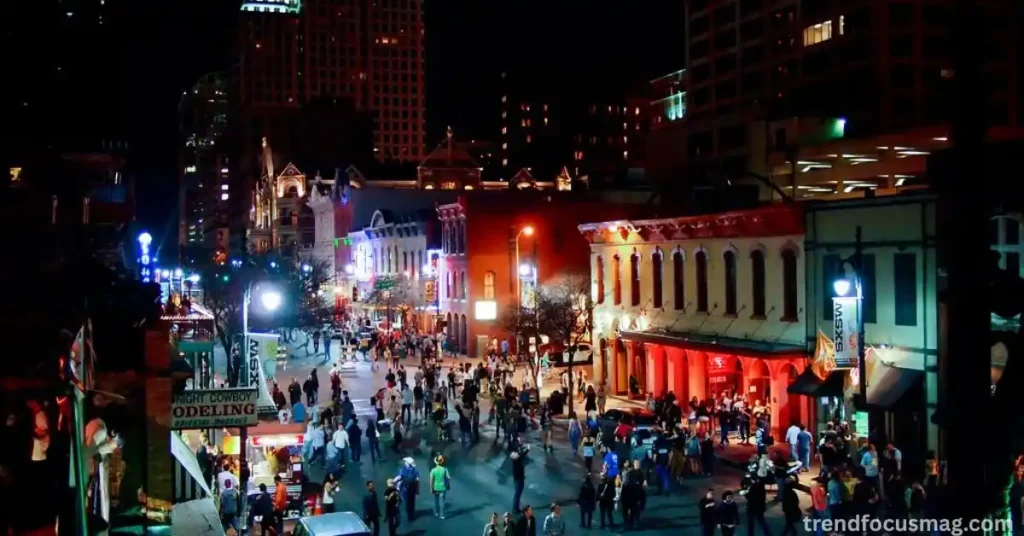
In less than 60 seconds, gunfire turned Austin’s iconic Sixth Street into a war zone. What investigators discovered afterward may have national security implications.
Austin Sixth Street Shooting 2026: The vibrant heart of Austin’s legendary nightlife was shattered in the early hours of Sunday, March 1, 2026, when a lone gunman unleashed a hail of gunfire on crowded Sixth Street. What began as a typical weekend evening ended with two people dead, fourteen wounded, and a city grappling with a tragedy that authorities are now investigating as a potential act of domestic terrorism influenced by international conflict.
This comprehensive report compiles all confirmed details from the Austin Police Department, the FBI, and eyewitness accounts to provide a clear, factual timeline of the events and the ongoing investigation.
The Attack: A Nightmare on Sixth Street
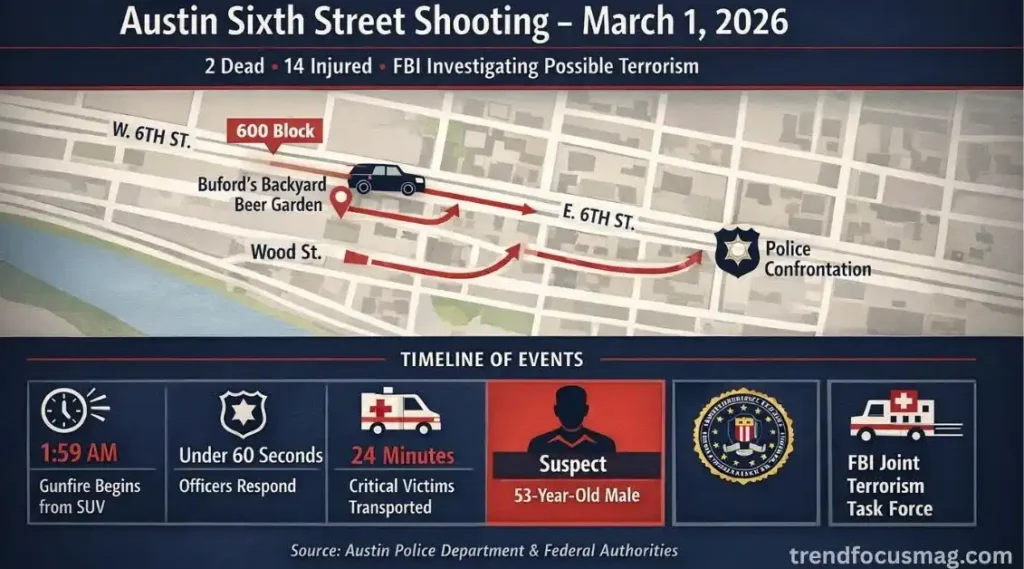
Just before 2:00 a.m. on Sunday, as bars along the bustling Market District prepared for last call, patrons at Buford’s Backyard Beer Garden became the first targets. According to Austin Police Chief Lisa Davis, the suspect, later identified as 53-year-old Ndiaga Diagne, drove a large SUV in the 600 block of West Sixth Street.
Witnesses described a confusing and terrifying scene. Diagne circled the block, then stopped his vehicle, activated its hazard lights, and began firing a handgun from the driver’s side window, directly at people on the crowded patio and sidewalk outside Buford’s.
“He put his flashers on, rolled down his window, and began using a pistol, shooting out of his car windows, striking patrons of the bar,” Chief Davis detailed in a press conference.
After the initial barrage, Diagne drove a short distance west, parked near Wood Street, and exited his vehicle. He then continued his attack on foot, now armed with a rifle, shooting at pedestrians and people in front of other establishments as he moved eastward along Sixth Street.
Law Enforcement Response: Seconds That Saved Lives
The response from Austin’s finest was remarkably swift, a fact that Mayor Kirk Watson and Chief Davis credit with preventing further loss of life. Due to the high-density nightlife area, officers from the Austin Police Department were stationed nearby as part of a routine weekend saturation patrol.
This proximity proved critical. Officers were on the scene and engaging the suspect in under a minute. As Diagne moved east on foot, armed with his rifle, he was met by officers advancing from the opposite direction.
“Our suspect was coming toward East Austin or East Sixth Street, officers were coming toward him, and at the intersection, he was shot and he was killed at this time,” Chief Davis confirmed.
🚨🇺🇸 Texas – Driverless Waymo Car blocking First Responders attempting to get to a terrorist mass shooting in Austin – is some next level dystopian shit. pic.twitter.com/LwnhGWiTZ9
— Concerned Citizen (@BGatesIsaPyscho) March 1, 2026
Simultaneously, the medical response was equally rapid. Paramedics from Austin-Travis County EMS (ATCEMS) were also embedded in the area as part of a special program during peak entertainment hours.
“We had medical care on site treating patients within 57 seconds,” said ATCEMS Chief Robert Luckritz. In total, over 20 EMS resources were deployed. Critically, all severely wounded patients were transported from the scene within 24 minutes, and the last of the 14 injured was en route to a hospital just 47 minutes after the first shots were fired. “There is no question in my mind that the quick response… made a difference and saved lives,” Mayor Watson stated.
The Victims: A Community in Mourning
The human toll of this violence is profound. Two individuals were pronounced dead at the scene. As of the latest reports, fourteen others were transported to local hospitals, with three initially listed in critical condition. Officials from St. David’s HealthCare confirmed that at least four of the injured have since been released, though others continue to receive treatment.
While authorities have not yet publicly released the identities of the deceased or all the wounded, the impact on the local community is already clear. University of Texas at Austin President Jim Davis confirmed that students were among those affected, stating, “Our prayers are with the victims and all those impacted, including members of our Longhorn family.” The city now waits for more information, holding the families of the victims in their thoughts.
The Suspect: Ndiaga Diagne
The shooter has been identified as **Ndiaga Diagne**, a 53-year-old naturalized U.S. citizen originally from Senegal. According to a Department of Homeland Security official, Diagne first entered the United States on March 13, 2000, on a B‑2 tourist visa. He later adjusted his status to lawful permanent resident in June 2006 based on his marriage to a U.S. citizen and was naturalized as a citizen on April 5, 2013.
Officials released the photo of the suspect in the Austin bar shooting that left two people dead over the weekend. credit: CNN https://t.co/Aprvld9NpF pic.twitter.com/GWxVG4FUck
— ARC El Paso (@ARCElPasoTV) March 2, 2026
Diagne initially resided in New York before eventually moving to Texas, where he held multiple addresses. His criminal record in the U.S. appears limited; a DHS official noted he was arrested in Texas in 2022 on a misdemeanor charge of “collision with vehicle damage.” Crucially, multiple law enforcement officials have stated they are reviewing past mental health encounters the suspect had while living in Texas, suggesting a potentially complex personal history that investigators are working to understand.
The Terrorism Investigation: The Iran Connection
The most significant and disturbing development in the case is the involvement of the FBI’s Joint Terrorism Task Force (JTTF). While a motive has not been officially confirmed, investigators have uncovered powerful indicators pointing to a potential act of terrorism.
FBI Acting Special Agent in Charge Alex Doran stated on Sunday, “There were indicators on the subject and in his vehicle that indicate a potential nexus to terrorism.” Since then, details have emerged providing context for that statement.
According to multiple law enforcement officials briefed on the case who spoke to CNN, investigators are actively exploring whether the attack was motivated by recent U.S. and Israeli strikes on Iran. A key piece of evidence is the clothing Diagne was wearing during the attack. An official told CNN that beneath a hoodie printed with “Property of Allah,” the suspect wore a shirt featuring an Iranian flag design.
Authorities are now meticulously examining Diagne’s digital footprint—including computers and phones seized from his home in Pflugerville, a suburb of Austin—for any propaganda, writings, or communications that could confirm his ideology and intent. The investigation is in its early stages, and as Agent Doran cautioned, “it’s still way too early in the process to determine an exact motivation.”
The Broader Context and Official Response
This tragic event has resonated far beyond Austin. Texas Governor Greg Abbott released a strong statement condemning the attack and vowing a robust response. He ordered the Texas Military Department to activate patrols to protect communities and critical infrastructure, including energy facilities and ports. He also directed the Texas Department of Public Safety to increase patrols and law enforcement presence in the Sixth Street area, particularly on weekends.
“This act of violence will not define us, nor will it shake the resolve of Texans,” Governor Abbott said, adding a stern warning that the state would respond aggressively to anyone “using the current conflict in the Middle East to threaten Texans.”
This shooting is not an isolated incident but part of a grim national trend. According to data from the Gun Violence Archive, which tracks mass shootings (defined as incidents where four or more people are shot or killed, excluding the shooter), this is already the 56th mass shooting in the United States in the first two months of 2026.
What Happens Next?
The investigation remains fluid and highly active. Key priorities for the FBI and APD include:
- Finalizing the Motive: Completing the digital forensic analysis of the suspect’s devices and interviewing associates to definitively determine if the attack was an act of terrorism.
- Releasing Victim Information: Officially identifying the deceased and injured victims in coordination with their families.
- Analyzing the Timeline: Reviewing all evidence to ensure a complete and accurate public account of the shooting.
The city of Austin now faces the difficult path of healing. Mayor Watson promised continued updates and emphasized the professionalism that saved lives. For residents who may have lost personal items at the scene, APD’s Victim Services can be reached at 512-974-5037.
This story is developing. We will continue to update this report as more information is officially released by authorities.
FAQs
Who was the suspect in the Austin shooting?
Authorities identified the suspect as Ndiaga Diagne, a 53-year-old naturalized U.S. citizen originally from Senegal.
How many people were killed in the Sixth Street attack?
Two people were killed and fourteen others were injured.
Is the FBI investigating the shooting as terrorism?
Yes, the FBI’s Joint Terrorism Task Force is investigating potential links to domestic terrorism.
Where did the Austin shooting occur?
The shooting happened in the 600 block of West Sixth Street in downtown Austin.
Was anyone arrested in connection with the Austin Sixth Street shooting?
Yes. The suspect, 53-year-old Ndiaga Diagne, was confronted by police and killed at the scene. No other arrests have been reported as of now.
More from TrendFocusMag:
- The Impact of Technology on Reading Habits and the Publishing Industry
- The Shift Toward Pedestrian-Centric Urban Planning in 2026
- About Filkizmiz253: A Digital Identity Explained
- 10 Unique Florida Souvenirs at 2026 Annual Floridiana Fest Sarasota

Our mission is to provide timely, trustworthy, and impactful stories that help our audience stay informed in a fast-moving world.